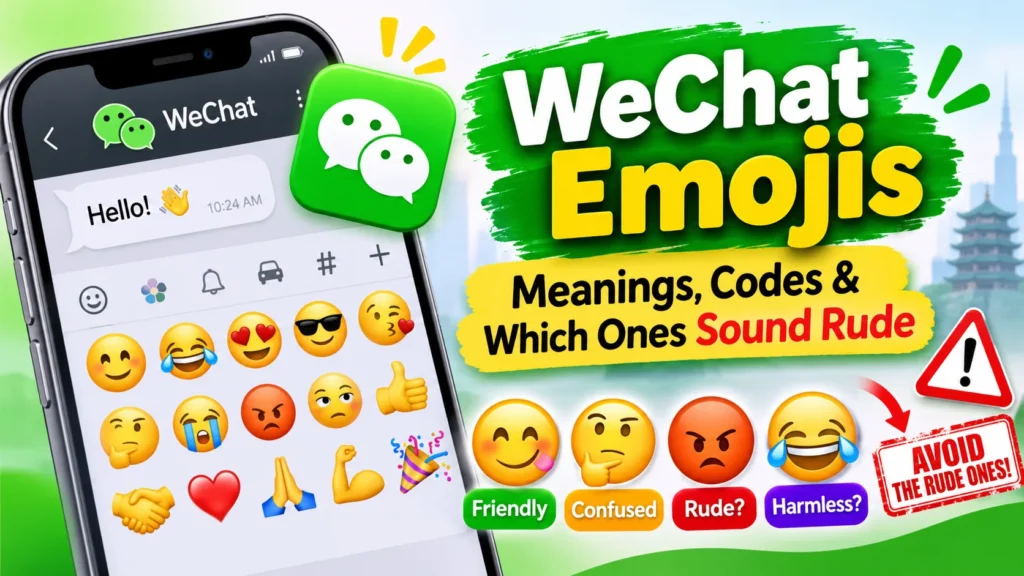
WeChat emojis (also called WeChat stickers, emoticons or shortcodes) are Tencent’s own set of about 100 custom faces and gestures, typed as bracket codes like [Smile] or [Grin]. They aren’t standard Unicode emojis, so they don’t always mean what the iPhone look-alike means. The classic trap is the plain smile: [Smile] 🙂 often reads as polite-but-cold, or even sarcastic, between peers, while [Grin] 😁 and [Chuckle] 🤭 are the safer friendly picks.
Below: a meaning table, what to reply when someone sends you a tricky one, and a full shortcode directory.
WeChat Emoji Meanings at a Glance
WeChat draws its own artwork, so the emojis in the first column are approximate look-alikes. Match by the shortcode, not the picture. English labels aren’t standardized and change between app versions.
| Look-alike | Shortcode (English / Chinese) | What it usually means | Watch out for |
|---|---|---|---|
| 🙂 | [Smile] / 微笑 | Polite, professional, a bit distant | Can feel cold or sarcastic between peers |
| 😁 | [Grin] / 呲牙 | Friendly cheer; one of the most used | Safe almost anywhere |
| 🤭 | [Chuckle] / 偷笑 | Quiet laugh; softens advice or a tease | Can come across as smug |
| 😳 | [Shy] or [Blush] | Humble, embarrassed; a polite “can you do me a favor?” | Not romantic by default |
| 🤦 | [Facepalm] / 捂脸 | “My bad,” helpless, embarrassed | Usually aimed at oneself |
| 🙄 | [Slight] / 白眼 (newer: 翻白眼) | Eye-roll, disdain | Not “confused” |
| 😬 | [Grimace] / 撇嘴 | Awkward refusal, bad news | Softens a “no” |
| 😮💨 | [Sigh] / 叹气 | Resignation, tiredness | Added in 2020 |
| 👍 | [ThumbsUp] (older label: 强) | Approval | Sincere for older users, curt for some younger ones |
| 👋 | [Bye] | Goodbye | Can feel like a brush-off in some chats |
| 🙏 (closest in function) | [Salute] or [Fist] (Quartz calls its version “Fight”) | Respect, thanks, apology | No exact standard match |
| none | [Commando] / 悠闲 | “That’s just how I am” | Even native users disagree on it |
| none | [Toasted] / 衰 | Bad luck, or “I’m speechless” | Friends may ask “what’s wrong?” |
Read It in Three Seconds
Before decoding any emoji, check three things. They settle most cases faster than any chart.
- Who sent it? A parent’s 👍 and a classmate’s 👍 are not the same message.
- What came right before it? A [Smile] after “Sorry, I’m late!” is fine. A [Smile] after “I said 6:30” isn’t.
- Are there words with it? An emoji alone is easy to misread. An emoji at the end of a sentence usually just sets the tone of that sentence.
Is the WeChat Smile Rude?
Not rude, exactly, but rarely warm between peers. The sources agree on the direction and disagree on how strong it is.
| Source | What it says about [Smile] |
|---|---|
| Quartz | Keeps things professional yet friendly; skip it with friends unless you’re over 40 |
| SCMP / Abacus | Usually reserved for your boss |
| The Chairman’s Bao | Friends may think you’re mocking them |
| Silas S. Brown (2020 note) | Some see it as mocking, so [Chuckle], [Grin], [Joyful] or [Laugh] are safer |
| Kaiwa guide | Calls it passive-aggressive and says to avoid it |
What to do about it: with friends, use [Grin] 😁, [Chuckle] 🤭 or [Joyful]. With a boss or someone older, [Smile] is fine, and older users often send it sincerely, so don’t read an aunt’s smile as an attack.
What to Reply When You Get One
These replies are practical suggestions, not official etiquette. Where a forum or editor’s advice exists, it’s noted.
| They sent | Likely means | A safe reply |
|---|---|---|
| 🙂 [Smile] from a friend | Distance or mild annoyance, depending on context | Check their words; if unsure, ask lightly: “Did I say something off? 😁” |
| 🙄 [Slight] | An eye-roll at what you said | Own it with [Facepalm] or clarify in words |
| [Hammer] | A playful knock on the head: “that was inappropriate, but I’m not mad” | On a Baidu forum, one user was advised to answer with a mischievous tongue-out emoji and “please help me improve” |
| [Toasted] | Bad luck, or “I have nothing to say to that” | Ask “What’s wrong?” or comfort them; on Baidu, a user in this spot was told to comfort her |
| [Commando] | “That’s how I am, deal with it” | Don’t overthink it, and let the words guide you |
| 😳 [Shy] / [Blush] | A favor is coming | Wait for the ask |
| 😬 [Grimace] | A refusal or bad news | Reply in words: “No worries, thanks for telling me” |
| 👍 from a parent | “Okay, got it” | Treat it as a sincere yes |
Odd Ones Worth Knowing
- [Smug] (傲慢): Closer to “scornful” than “smug.”
- [Pooh-pooh] (鄙视), [Bah!L], [Bah!R]: More scorn. WeChat has several versions, and nobody could explain the left-and-right pair beyond symmetry.
- [Scowl]: Quartz reads it as “What the hell?!” Its Chinese name, 发呆, means a dazed stare, according to a China Daily bilingual item, so the English label can mislead.
- [Determined] (奋斗): The headband is a Japanese hachimaki, shorthand for effort. It means “I’ll work hard,” not “thug life.”
- QQ penguins ([Waddle], [Tremble], [Twirl]): Cute, usually happy, sometimes angry. One editor says she sends them to her mother.
- [Onlooker]: The melon-eating onlooker, added in 2020, for watching drama unfold.
How to spot the distinctive ones
To see every design exactly as WeChat draws it, Emojipedia’s WeChat page shows the set beside its shortcodes. For the ones with no standard equivalent, these clues come from the cited sources:
| Shortcode | Look for | Don’t confuse with |
|---|---|---|
| [Smile] / 微笑 | A closed-mouth smile | [Grin], which shows teeth |
| [Grin] / 呲牙 | A smile with teeth showing | [Smile] |
| [Slight] / 白眼 | Raised eyebrows and the whites of the eyes | A “confused” face |
| [Commando] / 悠闲 | A face with a cigar | The English code suggests a different tone than the Chinese label, “relaxed” |
| [Determined] / 奋斗 | A headband | A “thug” look; it means effort |
| [Hammer] / 敲打 | A knocking motion aimed at the face’s own head | Someone hitting you; the face is the sender’s own |
| QQ penguins | A penguin in a scarf | A random mascot |
How WeChat Emojis Differ From Standard Emojis
- They aren’t Unicode. Emojipedia notes that WeChat’s custom designs don’t follow the Unicode Standard, and some use the same graphics Apple made for iOS.
- Two different panels. WeChat’s own emojis (called “Stickers” in the app) come from the smiley button inside WeChat, which is different from your keyboard’s emoji button. WeChat also supports standard emojis.
- Names aren’t fixed. Emojipedia says English shortcode names aren’t standardized. The proof is in the sources: a 2020 study called the thumbs-up “strong,” Emojipedia’s 2021 list uses [ThumbsUp], and TWOC and Quartz give different English names for similar emojis. Trust the Chinese name when it’s available.
- Some Chinese codes are shared. A few, like [微笑], work on both WeChat and Weibo.
- How many? It depends on the version. One study counted 104 in app version 6.7.4, a 2024 guide counts 121 including 24 shortcuts, and Emojipedia’s February 2021 list shows about 110 English shortcodes.
WeChat Shortcode Directory
This is the English shortcode list as Emojipedia recorded it in February 2021. The grouping into moods is mine, for easier browsing. Newer versions may add or rename codes, so check your own panel.
Happy and playful: [Happy] [Joyful] [Laugh] [Lol] [Grin] [Chuckle] [Smile] [Smirk] [Sly] [Tongue] [Hey] [Yeah!] [Awesome] [CoolGuy] [Smart] [Peace]
Affection: [Heart] [Kiss] [Hug] [Lips] [Shy] [Blush] [Flushed] [Blessing] [Rose] [BrokenHeart] [Wilt]
Sad and hurt: [Cry] [Sob] [TearingUp] [Whimper] [Frown] [Hurt] [Broken] [Let Down] [Sigh] [Concerned]
Annoyed and scornful: [Angry] [Scowl] [Scold] [Slight] [Smug] [Pooh-pooh] [Bah!L] [Bah!R] [Duh] [Boring] [Speechless] [Silent] [Shhh]
Awkward and embarrassed: [Awkward] [Grimace] [Facepalm] [MyBad] [Sweat] [Sweats] [Toasted] [Shrunken] [Dizzy]
Shock and fear: [Shocked] [Surprise] [Wow] [OMG] [Scream] [Terror] [Panic] [Aaagh!] [Tremble]
Tired and unwell: [Sleep] [Drowsy] [Yawn] [Drool] [Sick] [Puke]
Gestures and attitude: [ThumbsUp] [ThumbsDown] [OK] [NoProb] [Clap] [Fist] [Salute] [Respect] [Worship] [Beckon] [Shake] [Bye] [GoForIt] [KeepFighting] [Determined] [LetMeSee] [Emm] [Onlooker] [Commando] [Doge] [NosePick] [Trick] [Hammer] [Twirl] [Waddle]
Objects and celebration: [Packet] [Gift] [Cake] [Party] [Fireworks] [Beer] [Coffee] [Watermelon] [Moon] [Sun] [Pig] [Skull] [Poop] [Bomb] [Cleaver]
Which Emoji for Which Person
Tendencies from the sources, not rules.
| Situation | Safer picks | Think twice |
|---|---|---|
| Boss or elder | 🙂 [Smile], 😳 [Shy], [Salute] for thanks | [Slight], [Smug], [Hammer] |
| Close friend | 😁 [Grin], 🤭 [Chuckle], 🤦 [Facepalm] | A bare 🙂 |
| New contact | 🙂 [Smile], 😁 [Grin] | Eye-roll or scorn emojis |
| Refusing or bad news | 😬 [Grimace], 😳 [Blush] | Joking emojis |
Which Age Group Uses What
The newest figures I could verify come from WeChat’s 2018 and 2019 reports, so this is a snapshot, not today’s data.
| Birth group | Favorite (2018 report) |
|---|---|
| After 2000 | 🤦 Facepalm |
| 1990s | 😂 Face with Tears of Joy |
| 1980s | 😁 Toothy grin |
| 1970s | Covering-mouth laugh ([Chuckle]-type) |
| 55 and older | 👍 Thumbs up |
The 2019 overall top five was facepalm, grin, chuckle, thumbs-up and rose. The same emoji can be sincere from a parent and sarcastic from a classmate, so age is worth factoring in.
What If You Sent the Wrong One?
A 2020 study found that WeChat places some opposite-meaning emojis close together, and users reported tapping the wrong one. Of 103 collected incidents, most involved friends (about 30%) and the fewest involved a leader (about 9%). It was a small sample, so treat the percentages as a rough guide.
Fix: send one line right away: “Oops, wrong emoji! I meant congratulations!” Then carry on. Before sending thanks, congratulations or an apology, take half a second to check what you tapped.
Three Short Examples
Invented chats, to show how context changes meaning.
Asking a senior colleague Mei: Mr. Zhou, could you check slide 4 before Friday? 😳 ([Shy]) Polite humility, not flirting.
Between friends Dan: Are we meeting at 7?
Kai: I said 6:30 🙂 ([Smile]) After a correction, a bare [Smile] sounds clipped. A [Grin] would have sounded friendly.
Parent and child Lin: I’ll be home late.
Mom: 👍 ([ThumbsUp]) Mom means “okay.” Lin might read it as the end of the conversation. Neither is wrong.
New and Hidden WeChat Emojis
- Early 2020: ten new emojis, including the onlooker, “Emm,” “go for it,” “my bad” and the doge face.
- November 2020: six more: rolling eyes, 666 (awesome), let me see, sigh, bitter and broken. [Broken] (裂开) is internet slang for being so frustrated you feel split apart.
- Hidden animations: one guide says typing “Happy Birthday,” “Miss You” or “XOXO” triggers special effects. I couldn’t verify it, so test it in your own app.
FAQ
What does [Smile] mean on WeChat?
Polite and professional, but often cold between peers. See the smile table above.
How do I send a WeChat emoji?
Tap the smiley button inside WeChat, or type the shortcode in brackets, such as [Grin].
Are WeChat emojis the same as iPhone emojis?
No. They’re Tencent’s own designs, though a few match Apple’s artwork.
Can I use regular emojis in WeChat?
Yes. WeChat supports standard emojis and its own shortcodes.
Will WeChat emojis show up in other apps?
Not as WeChat designs, because they aren’t Unicode. Typing the bracket code elsewhere just shows the text.
Which WeChat emoji is the safest?
[Grin] 😁 for friends, [Smile] 🙂 for a boss or elder.
What does the cigar emoji mean?
[Commando]. Read it as “that’s how I am,” and let the surrounding words decide.
Why do older relatives send 👍 so much?
WeChat’s 2018 report put it as the favorite of users aged 55 and over, as a quick, sincere sign of approval.
DISCOVER MORE ARTICLES
Adult Emojis Meaning: Flirty, Sexual or Innocent? (2026-27)
Discord Emojis: How to Use, Find & Add Custom Emojis
Fire Emojis : What They Mean in Texts (and How to Reply)

Shahzad
Hi, I’m the creator behind EmojiNova, a passionate emoji enthusiast who loves exploring the fun and creative world of digital communication. I enjoy helping people discover emoji meanings, understand emoji symbols, and find the perfect emojis to express their feelings.
Through EmojiNova, my goal is to make online communication easier, more expressive, and more enjoyable. Whether you’re looking for emoji meanings, symbol explanations, or creative ways to use emojis in everyday conversations, I’m here to help you express yourself with confidence.
Thanks for being part of the EmojiNova community!