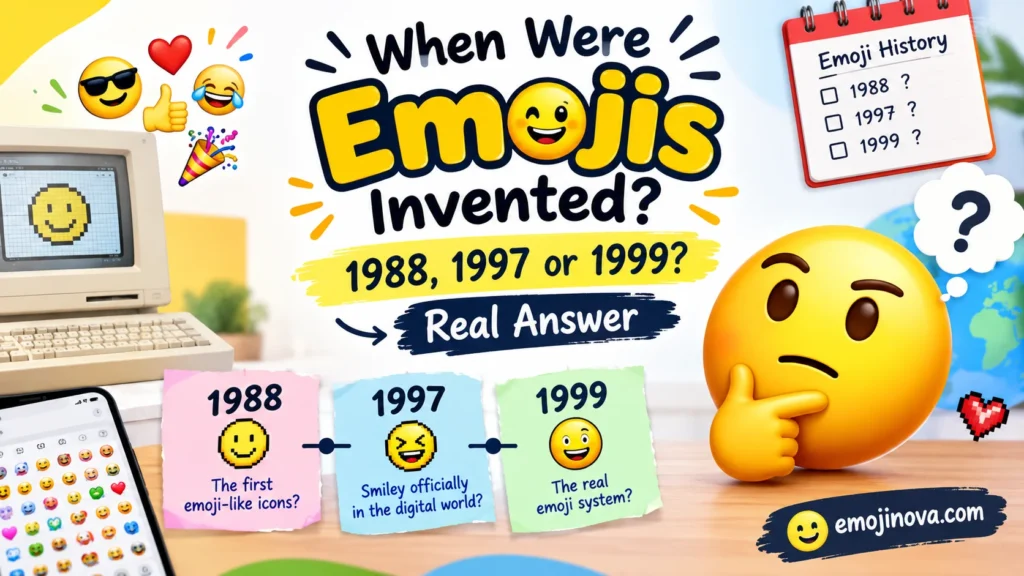
Emojis were invented in Japan in the late 1990s: the first known emoji set on a mobile phone shipped in November 1997 (SoftBank), and Shigetaka Kurita’s famous 176 emoji launched with NTT DoCoMo in 1999. Emoji-like symbols appeared on Japanese organizers as early as 1988, and emoji entered Unicode in 2009–2010, which is what made them universal.
Related: first emoji ever, who invented emojis, history of emojis, Shigetaka Kurita, emoji vs emoticon.
🗓️ Emoji Invention Timeline: Key Dates at a Glance
| Year | Event | Why it matters |
|---|---|---|
| 1982 | Scott Fahlman proposes :-) and :-( | The emoticon, a separate invention |
| Oct 1988 | Sharp PA-8500 organizer ships with 100+ pictures | Earliest known emoji-like set |
| Aug 1990 | NEC PI-ET1 organizer ships with 130+ symbols | Another proto-emoji set |
| 1995 | DoCoMo Pocket Bell pagers popularize a pixel heart ❤ | Showed demand for icons in messages |
| Nov 1997 | SoftBank (then J-Phone) SkyWalker DP-211SW carries 90 emoji | First emoji set on a mobile phone |
| Early 1999 | DoCoMo i-mode launches with Kurita’s 176 emoji | The set that made emoji popular |
| Nov 2008 | iPhone gets emoji in Japan | Apple’s first emoji support |
| 2009 | Unicode 5.2 adds the first 114 emoji characters | First emoji in Unicode |
| 11 Oct 2010 | Unicode 6.0 adds the other 608 of the original 722 | Emoji become a global standard |
| Oct 2011 | iOS 5 brings the emoji keyboard worldwide | Mass adoption outside Japan |
| 2013 | Android 4.4 KitKat adds emoji to Google’s keyboard and redesigns them | Android users get emoji |
| 2015 | Skin-tone modifiers arrive; 😂 is Oxford’s Word of the Year | Emoji enter mainstream culture |
| 16 Sep 2026 | Unicode 18.0 approves nine more emoji | The set keeps growing |
Which Date Should You Use?
Sources disagree because “invented” can mean five different things.
| If your question is… | Answer | Date |
|---|---|---|
| Earliest emoji-like pictures you could type into text? | Sharp PA-8500 | October 1988 |
| First emoji set on a mobile phone? | SoftBank SkyWalker DP-211SW | November 1997 |
| The set that made emoji famous (the textbook answer)? | Kurita’s DoCoMo set | Early 1999 |
| First emoji characters in Unicode? | Unicode 5.2 | 2009 |
| When did emoji become a universal standard? | Unicode 6.0 | October 2010 |
For a school answer, “late 1990s in Japan” is safe. If you need one year, 1999 is the traditional answer, but 1997 is more accurate for “first emoji set on a phone.” Emojipedia, which tracks emoji history, corrected its own records in 2019 to credit SoftBank’s 1997 set as first.
Before Emoji: The Proto-Emoji Sets (1988–1995)
Sharp PA-8500 (1988) and NEC PI-ET1 (1990)
In 2024, Emojipedia reported research by developer Matt Sephton showing that Japanese electronic organizers had emoji-like sets long before phones did. Sharp’s PA-8500 (October 1988) is the earliest known example of a character set that resembles a modern emoji keyboard. NEC’s PI-ET1 followed in August 1990, and Sharp’s Zaurus PI-4000 (June 1994) carried nearly 200 symbols at 12×12 pixels.
These sets already had familiar categories: people, smileys like 😄, food like 🍚, objects like 📺, sports like 🎾, weather, hearts like 💘, and zodiac signs. The symbols had their own character codes and could sit inside a line of text.
Emojipedia calls them “proto-emoji” rather than the first emoji, and says even older sets could still turn up. Treat 1988 as the earliest known date, not a final one.
DoCoMo’s Pocket Bell heart (1995)
DoCoMo’s Pocket Bell pagers became hugely popular in Japan largely because users could send a simple pixel heart (❤). That feature is frequently cited as an inspiration for DoCoMo’s 1999 emoji set.
The First Mobile Emoji Set: SoftBank, 1997
In November 1997, J-Phone (now SoftBank) released the SkyWalker DP-211SW with 90 emoji designs, making it the first mobile phone known to carry an emoji set. The phone sold poorly and the emoji weren’t supported on other SoftBank devices, so this chapter was nearly forgotten until Emojipedia highlighted it in 2019.
Two details give the 1997 set weight. Historian Keith Houston notes the word “emoji” appears in the J-Phone manual of that year. And Emojipedia says the ancestor of 💩 (Pile of Poo) came from this release.
The Set That Made Emoji Famous: Shigetaka Kurita, 1999
In early 1999, NTT DoCoMo launched its i-mode mobile internet service with 176 emoji designed by Shigetaka Kurita. Each was 12×12 pixels, covering weather, transport signs, technology, and facial expressions. The set spread because i-mode was a hit, and in 2016 New York’s Museum of Modern Art added Kurita’s original emoji to its collection.
Why Kurita created them
i-mode limited messages to 250 characters, so users needed shorthand. Kurita also found text-only screens hard to read at a glance: weather forecasts appeared as the word “fine,” while Japanese TV used a picture of the sun.
The heart mattered most. DoCoMo’s pager with a heart symbol sold well, and when a later business-oriented model dropped it, sales fell, according to Kurita’s own account. Kurita has said a heart makes a message feel positive, whatever the text says. He drew on weather symbols, public signs, zodiac signs, and manga-style pictures like a light bulb, and made five faces: happy, angry, sad, surprised, and perplexed.
One more detail: Kurita has said he also designed a poo, but DoCoMo rejected it to protect its corporate image. The 💩 that survived came from SoftBank’s earlier set.
So who gets the credit?
Kurita designed the set that made emoji popular. He did not design the earliest emoji-like symbols (1988) or the first phone set (1997, designer unknown). “Popularized emoji” is the accurate description of his role.
How Emoji Went Global (2008–2015)
For about a decade, emoji stayed Japanese and fragmented. DoCoMo, SoftBank, and au by KDDI each used their own incompatible sets, so an emoji sent across carriers could show up as a blank box.
Apple adds emoji in Japan (2008)
In November 2008, iPhone OS 2.2 added emoji for Japanese users, using SoftBank’s encoding. They weren’t visible to the rest of the world.
Unicode adds emoji (2009–2010)
Apple and Google pushed for emoji to be added to Unicode, the standard that lets every device show the same character, and a formal proposal was published in January 2009. Unicode’s own emoji report explains what happened next: a set of 722 characters was defined as the union of the emoji used by Japanese carriers. 114 were already in Unicode 5.2 (2009), and the remaining 608 arrived in Unicode 6.0 on 11 October 2010.
iOS 5 and Android (2011–2013)
iOS 5 (October 2011) gave iPhone users worldwide a built-in emoji keyboard, which is why many people outside Japan first noticed emoji around 2011–2012. Android followed in 2013, when Google redesigned its emoji in Android 4.4 KitKat and made them part of its keyboard.
Skin tones and 😂 Word of the Year (2015)
In 2015, Unicode 8.0 added five skin-tone modifiers based on the Fitzpatrick scale. The same year, Oxford Dictionaries named 😂 (Face with Tears of Joy) its Word of the Year, the first time a pictograph won.
Emoji vs Emoticon
| Emoticon | Emoji | |
|---|---|---|
| Example | :-) | 😊 |
| What it is | Punctuation arranged like a face | An image character |
| Invented | 1982, Carnegie Mellon University | Late 1990s Japan (proto-sets from 1988) |
| Credited to | Scott Fahlman (19 September 1982) | Japanese device makers; Kurita popularized it |
| Origin | US computer science community | Japanese mobile phones |
Emoji didn’t grow directly out of emoticons. The word “emoji” also isn’t “emotion + icon”: it comes from Japanese 絵 (e, picture) and 文字 (moji, character).
Common Myths About Emoji’s Invention
- “Kurita invented the first emoji in 1999.” His was the best-known early set, but SoftBank’s 1997 set and Sharp’s 1988 set came earlier.
- “Apple invented emoji.” Apple helped bring them to Unicode and the world, but Japanese carriers used emoji for about a decade first.
- “Emoji started in 2010 or 2011.” Those are the years of standardization and global rollout, not invention. Even Unicode’s first emoji arrived a year earlier, in 2009.
- “Emoji means emotion icon.” It means picture character.
FAQs
What was the first emoji ever?
No single “first emoji” can be named. The earliest known emoji-like set is Sharp’s PA-8500 (1988), and the first emoji set on a phone is SoftBank’s 90 emoji from November 1997.
When was the first emoji sent?
There’s no verified record of a “first emoji message.” What can be dated is when sets first shipped: 1988 on an organizer, 1997 on a phone, 1999 on i-mode.
Who invented emojis?
Shigetaka Kurita is the person most often credited, for DoCoMo’s 176 emoji in 1999. SoftBank’s earlier 1997 set has no named designer.
When did emojis come to iPhone?
Japan got emoji on iPhone in November 2008. The worldwide emoji keyboard came with iOS 5 in October 2011.
When did emojis become part of Unicode?
The first 114 emoji characters were added in Unicode 5.2 (2009), and the main batch arrived with Unicode 6.0 on 11 October 2010.
How old are emojis?
Counting Kurita’s 1999 set, about 27 years. Counting SoftBank’s 1997 set, about 29. Counting the 1988 proto-emoji, about 38.
How many emojis are there now?
Unicode 18.0 (16 September 2026) specifies 3,972 emoji in total, counting sequences and variants such as skin tones and flags. The original 1997 SoftBank set had 90.
DISCOVER MORE ARTICLES
March Emojis: Which to Use for Spring, St. Patrick’s & More
Emoji Memes: Funny Meanings, Trends & Popular Examples
Special Emojis: Hidden Meanings, Symbols & New Icons

Shahzad
Hi, I’m the creator behind EmojiNova, a passionate emoji enthusiast who loves exploring the fun and creative world of digital communication. I enjoy helping people discover emoji meanings, understand emoji symbols, and find the perfect emojis to express their feelings.
Through EmojiNova, my goal is to make online communication easier, more expressive, and more enjoyable. Whether you’re looking for emoji meanings, symbol explanations, or creative ways to use emojis in everyday conversations, I’m here to help you express yourself with confidence.
Thanks for being part of the EmojiNova community!