“Old emojis” can mean three different things, so here is the quick route to each:
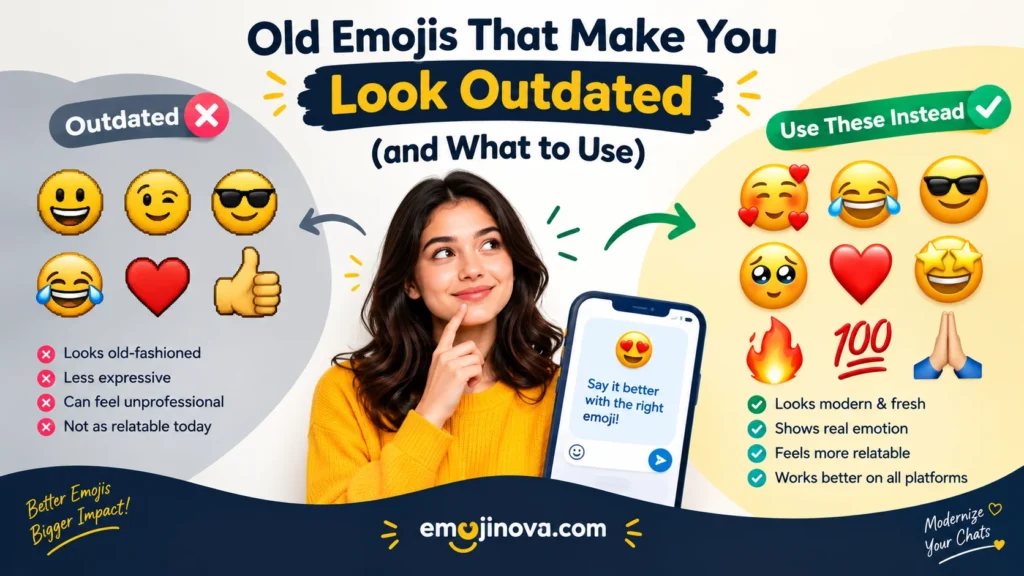
- Emojis that make you seem old or out of touch: 👍 ❤️ 👌 ✔️ 💩 😭 🙈 👏 and, most famously, 😂. Jump to the list
- How the first emojis looked (pixel sets, early iPhone and Android designs). Jump to old designs
- Emojis that show older people (👴 👵 🧓). Jump to older person emojis
Most searchers want the first one, so we start there.
Which Emojis Seem “Old”?
Short answer: In a 2021 survey by Perspectus Global, people aged 16 to 29 named 👍 as the emoji most likely to make a sender seem old, followed by ❤️, 👌, ✔️, 💩, 😭, 🙈 and 👏. The laugh-cry face 😂 is the other classic example, and it comes from separate coverage rather than that list.
| Rank | Emoji | Name | Typical meaning | Possible reason it feels “old” (our reading) |
|---|---|---|---|---|
| 1 | 👍 | Thumbs Up | OK, agreed, received | Can read as curt or cold |
| 2 | ❤️ | Red Heart | Love, thanks, warmth | Feels like the default heart |
| 3 | 👌 | OK Hand | Fine, perfect | Tied to earlier emoji habits |
| 4 | ✔️ | Check Mark | Done, confirmed | Reads as formal or administrative |
| 5 | 💩 | Pile of Poo | Joke, mild disgust | Feels like a throwback novelty |
| 6 | 😭 | Loudly Crying Face | Sadness, or laughing hard | See the note below |
| 7 | 🙈 | See-No-Evil Monkey | Embarrassment, “oops” | Playful in an older-feeling way |
| 8 | 👏 | Clapping Hands | Applause, praise | Can read as earnest |
The survey only ranked these emojis. It did not explain why, so the last column is our interpretation, not a survey finding. News outlets that reported the survey also disagree on entries nine and ten, so the table shows only the eight they all share.
What this list does and doesn’t prove
The survey asked 2,000 people between 16 and 29 which emojis felt old-fashioned. That tells you what one age group said about emoji, not how anyone actually behaves, and not how every friend group, workplace or country feels. It is a snapshot of opinion from 2021, and emoji habits move quickly.
Is the list still current?
Newer sources point the same way, with a twist. A July 2025 World Emoji Day list from Babbel and Emojipedia describes 👍 as something Gen Z often sees as passive-aggressive or dismissive, and says they also use it ironically. It lists 💀 as the way younger users say “I’m dead” when something is funny. A language expert quoted alongside it says Gen Z uses emojis less as literal symbols and more as tone-setters.
The twist: “old” is less about the emoji and more about using it literally. Younger users often use the very same emojis with irony, which is why a 👍 can be hostile from one person and a joke from another.
Culture matters too. An Eastern Eye piece on British Asian households notes that older relatives may still see a thumbs up or red heart as polite and affectionate, and that Gen Z often prefers typed replies such as “noted” or “done”.
Why These Emojis Feel Old
👍 Thumbs Up: the biggest source of friction
Thumbs up is the one that causes real misunderstandings. Fox News reported that some Gen Z users find it passive-aggressive or rude. The discussion grew from a Reddit post in which a 24-year-old said older co-workers’ constant thumbs-ups felt unsettling, while older users were baffled because they meant a plain “OK”.
Both sides have a point. To the sender it is a fast acknowledgement. To the receiver it can feel like the conversation was closed with no warmth added.
Work chat, where it is fine:
Dan: Can you send the report by 3?
Priya: Sending it now.
Dan: 👍
Here 👍 simply means “received”. Nothing emotional is at stake.
A personal message, where it can land badly:
Sana: I’m really stressed about the move.
Omar: 👍
The same emoji now looks dismissive, because the situation called for a human response.
❤️ Red Heart: sincere, and sometimes too plain
A red heart is the most literal “I care” emoji, which is why it works so well between family and friends, and also why some younger users treat it as the plain default.
Hana: Mom, I passed my driving test!
Mom: ❤️❤️
Here the repeated heart reads as proud and warm. Between relatives that is usually exactly right. Where it can feel flat is a long, detailed message answered with a single ❤️ and nothing else. The emoji is not wrong, but a few words would carry more.
👌 ✔️ 👏: straightforward approval
These three share a trait with ❤️: they say exactly what they mean (fine, done, well done). Younger users often favor irony and exaggeration, so literal emojis can come across as old-fashioned. That is an interpretation of the pattern, not something the survey measured.
😂 Laugh-Cry Face
Coverage of a CNN Business report described younger users moving away from 😂 because they saw parents, siblings and other older people using it. The replacements people mention are 💀, 😭 and a plain “lol”.
Mia: My brother sent me his flight selfie and he’s asleep in it
Ella: 💀
Here 💀 means “I’m dead”, meaning laughing so hard it could kill me. It does the job 😂 used to do.
😭: on the “old” list, yet also a replacement?
This looks contradictory, and it is. 😭 appears in the survey’s old list, while the same coverage names it as a modern stand-in for 😂. The likely explanation is that the emoji matters less than the tone. A literal 😭 for real sadness is ordinary. An exaggerated “I’m sobbing 😭😭😭” about something funny is the younger usage. If you see both claims online, that is why.
🙂 😉 😜: not “old”, but easy to misread
A few emojis are less about age and more about tone. One explainer on generational usage says 🙂 is often read as passive-aggressive, and a workplace guide says winking faces like 😉 and 😜 can come across as insincere to younger colleagues. These are commentary, not research.
Lena: Can we move the meeting to Thursday?
Chris: 🙂
Chris may simply mean “sure”. A younger reader might wonder if Chris is annoyed. With no words attached, the emoji leaves both readings open, so a person who always uses 🙂 is probably just smiling.
What to Send Instead (If You Want To)
You don’t have to change anything if your messages land well. If you do want to match a younger group, these are the swaps most often mentioned:
| Instead of | Try | Works best when |
|---|---|---|
| 😂 | 💀 or 😭 | Reacting to something funny among friends |
| 👍 | “sounds good”, “done”, “on it” | Work chats, or when warmth matters |
| 🙂 | A plain word, or no emoji | You want to avoid sounding cold |
| ❤️ | A short sentence, or a different heart | You want to say more than the default |
A few practical rules:
- Know your audience. Use what feels natural with friends and family.
- Add words when tone matters. A short phrase beats any emoji swap.
- Don’t over-read others. A thumbs up from a parent or manager rarely means irritation.
- Don’t force it. Trendy emojis used awkwardly look less natural than your usual ones.
Can an Emoji Really Show Someone’s Age?
Not reliably. Certain emojis are associated with older usage patterns, but that is a trend, not proof. Context outweighs the emoji itself, groups differ, and plenty of people use “old” emojis on purpose. In the 2021 survey, 78% of people said they had used an emoji before learning it carried a different meaning, which is a reminder that emoji interpretation is shaky for everyone.
Old Emoji Designs
If you meant the way emojis used to look, here is how things developed.
The first emojis
The set most people call the first was created in 1999 by NTT DOCOMO for its i-mode phone internet service. According to the M+ museum in Hong Kong, the first 176 designs were made by Shigetaka Kurita and architect Jun Aoki and each fits in a tiny 12×12 pixel grid, with 76 more following in 2002. Emojipedia has since reported finding earlier emoji-like sets from 1988 and 1990, so “first” depends on how you count.
Apple’s early look
Apple added an emoji keyboard in 2008 in iPhone OS 2.2, first for Japan, then worldwide with iOS 5 in 2011. Emojipedia notes that iOS 5.1 was Apple’s first set built on the newly approved Unicode code points, using designs similar to the 2008 ones at higher resolution. Apple’s designs have stayed relatively stable since 2008, apart from resolution and people-emoji updates.
Android’s early look
Android’s early sets looked very different. Emojipedia describes a 2012 set where many smileys were drawn as alien creatures. Google’s later blob-style emojis are now remembered fondly by many users.
Why some old designs changed meaning
Designs can change how an emoji reads. Emojipedia shows that 😁 once looked more like a grimace on iPhone than the cheerful grin it shows today. A pistol emoji is another well-known example: Apple replaced its realistic gun with a toy water pistol, and other platforms eventually followed.
Why the same emoji looks different on different phones
An emoji is a standard character, but each company draws its own version. Samsung, for instance, has used its own glossy designs since 2014, and Windows 11 introduced a softer pastel look. To see how a specific emoji used to look, Emojipedia’s emoji archive lets you click any emoji and browse its previous designs on each platform.
Older Person Emojis
If your search was about emojis that depict older people:
| Emoji | Name | Notes |
|---|---|---|
| 👴 | Older Man | Used for grandfathers or elderly men. In Unicode since version 6.0 (2010) |
| 👵 | Older Woman | Used for grandmothers or elderly women. In Unicode since version 6.0 (2010) |
| 🧓 | Older Person | Gender-neutral option. Its official Unicode character name is “Older Adult”; it arrived in Unicode 10.0 in 2017 |
| 🧑🦳 | Person with White Hair | Similar, but usually drawn without wrinkles |
These are used literally for relatives, and sometimes jokingly, such as “I woke up like 👵” to mean feeling old.
Frequently Asked Questions
What emojis make you look old?
In the 2021 Perspectus Global survey, the top eight were 👍, ❤️, 👌, ✔️, 💩, 😭, 🙈 and 👏. 😂 is widely cited as well.
Is the thumbs up emoji rude?
Not by nature. Some younger users read it as curt or passive-aggressive, while many older users mean “OK”. Context decides.
Is 😂 outdated?
Some Gen Z users associate it with older generations, though it is still widely used and understood.
What was the first emoji set?
The 1999 NTT DOCOMO set of 176 pixel emojis is usually called the first, though Emojipedia has reported earlier sets.
Do emojis look the same on every phone?
No. The character is standard, but each platform draws its own design.
What is the gender-neutral old person emoji?
🧓 Older Person. Its official Unicode character name is “Older Adult”.

Shahzad
Hi, I’m the creator behind EmojiNova, a passionate emoji enthusiast who loves exploring the fun and creative world of digital communication. I enjoy helping people discover emoji meanings, understand emoji symbols, and find the perfect emojis to express their feelings.
Through EmojiNova, my goal is to make online communication easier, more expressive, and more enjoyable. Whether you’re looking for emoji meanings, symbol explanations, or creative ways to use emojis in everyday conversations, I’m here to help you express yourself with confidence.
Thanks for being part of the EmojiNova community!