Emojis differ in four ways: what they show, how they are built, how they look on your phone, and what people actually mean when they send them. The fourth one causes almost all the confusion, because the same emoji can mean opposite things to different senders. If you only need one answer, skip to the lookup table below. If you want to understand why emojis behave the way they do, keep reading.
Quick answer: four ways emojis differ
| Difference | What it means | Example |
|---|---|---|
| Category | What the emoji depicts | 🍕 food, ✈️ travel, 🇨🇦 flag |
| Construction | One character, or several joined together | 👍 is one character, 👍🏽 adds a skin tone, 👩🎓 joins characters |
| Appearance | How your device draws it | 😬 looks different on an iPhone and on a Samsung |
| Meaning | What the sender intends | 😭 can mean sad, or “that’s hilarious” |
Find the right emoji by what you want to say
Pick the feeling you want, then read the last column before you send.
| You want to say | Try | It usually reads as | Heads-up |
|---|---|---|---|
| That’s funny | 😂 | Amused, a light laugh | Some younger users find it dated |
| That’s really funny | 🤣 | A bigger laugh | Often sent together with 😂 |
| I’m dying laughing | 💀 | Laughing so hard it “killed” you | Slang. In a serious chat it reads as dark |
| Too funny, or too much | 😭 | Laughing, overwhelmed, or truly sad | The words around it decide which |
| I love this | ❤️ | Love, strong affection, or a warm “like” | From a coworker it is usually friendly, not romantic |
| I adore this | 😍 | Admiration or a crush | Used for food and shoes as often as people |
| Thank you | 🙏 | Thanks, please, hope, or prayer | Add words when the topic is serious |
| I’m touched | 🥹 | Moved, grateful, emotional | Can also mean “so sad” or “so cute” |
| Got it, agreed | 👍 | Approval or acknowledgment | Can feel curt in an emotional conversation |
| Deal | 🤝 | Agreement, partnership | Slightly formal |
| Respect | 🫡 | Respect, “understood” | Often playful |
| Well done | 👏 | Applause or emphasis | Repeated between words it can sound pointed |
| I’m sad | 😢 | Quiet sadness, disappointment | Softer than 😭 |
| Heartbroken | 💔 | Heartbreak or sympathy | Also used for small letdowns |
| I’m annoyed | 🙄 | Eye-roll, exasperation | Can sound dismissive |
| Awkward, oops | 😬 | Nervous, cringing | Often mistaken for a grin |
| I’m embarrassed, I give up | 🫠 | Overwhelmed, ironic surrender | Tone is usually joking |
| I’m shocked | 😲 | Surprise | Good or bad depending on the news |
| Sly, smug, flirty | 😏 | Smirking, playful | Flirty or mean, depending on context |
| Fine, whatever | 🙂 | Polite, neutral, or sarcastic | A short reply plus 🙂 can feel cold |
| That’s impressive | 🔥 | Great, exciting, “hot” | Can also be literal fire or heat |
| Make it shine | ✨ | Positivity or emphasis | Placed around words it can sound ironic |
| Sending support | 🫶 | Affection, gratitude, support | Softer and more casual than ❤️ |
| Hmm, not sure | 🤔 | Thinking or doubt | Can read as skeptical |
| Please, I’m begging | 🥺 | Pleading, soft, “so cute” | Usually playful, not literal |
| 100% agree | 💯 | Full agreement, “perfect” | Informal |
| I’m watching this | 👀 | Interest, “tell me more” | Can hint at gossip |
| Phew, close call | 😅 | Relief or a nervous laugh | Can also signal mild embarrassment |
| It’s a secret | 🤫 | Quiet, “keep this between us” | Playful, not an order |
| You’ve got this | 💪 | Strength, pride, encouragement | Can be literal (gym talk) |
| Congratulations | 🎉 | Celebration | Positive and hard to misread |
| Fingers crossed | 🤞 | Hope or good luck | Works best with words saying what you hope for |
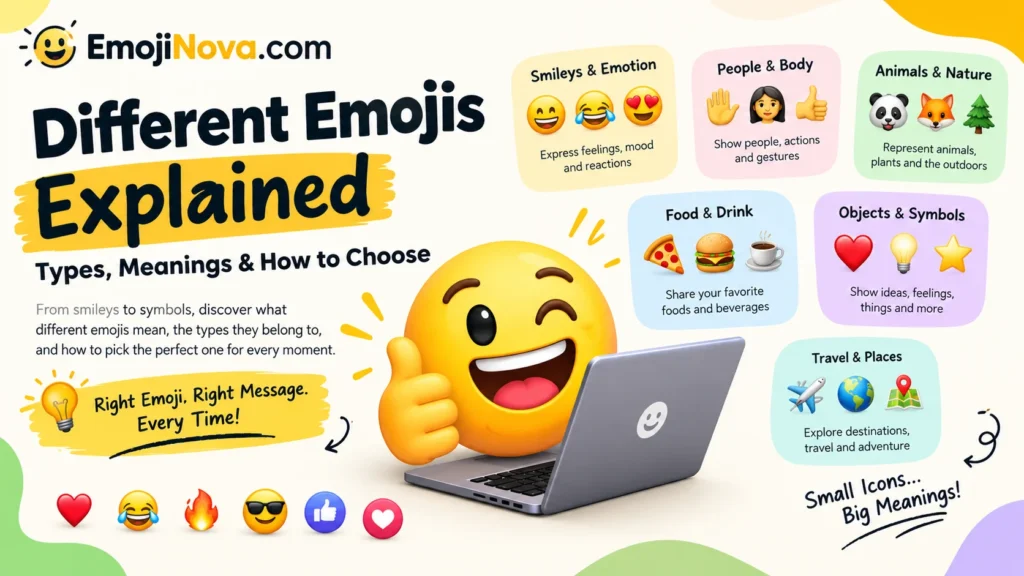
Different emojis by category
Keyboards sort emojis into groups so you can browse them. These are the groups most people see.
| Group | Examples | Typically used for |
|---|---|---|
| Smileys & Emotion | 😀 😢 😡 ❤️ | Tone and feeling |
| People & Body | 👋 🙏 👨🍳 | Gestures, people, roles |
| Animals & Nature | 🐶 🌻 🌧️ | Pets, plants, weather |
| Food & Drink | 🍕 ☕ 🍓 | Meals and snacks |
| Travel & Places | ✈️ 🏠 🌍 | Trips, buildings, landmarks |
| Activities | ⚽ 🎮 🎉 | Sports, hobbies, celebrations |
| Objects | 📱 💡 🎁 | Everyday items |
| Symbols | ✅ ❌ ♻️ | Signs, arrows, shapes |
| Flags | 🇵🇰 🏁 🏴 | Countries, regions, markers |
These groups are for browsing, not strict rules. Unicode itself describes its categories as broad, and an emoji can fit more than one. The labels also change. Unicode’s chart documentation still uses the older name “Smileys & People,” which keyboards now split into Smileys & Emotion and People & Body.
Different emojis by how they are built
Some emojis are a single character. Others are assembled from several. You only notice this when something goes wrong, for example when a profession emoji shows up as two separate icons.
| Type | Example | How it works |
|---|---|---|
| Single character | 😀 | One emoji, one symbol |
| Skin-tone variant | 👍🏻 👍🏽 👍🏿 | A base emoji plus one of five skin-tone modifiers |
| Joined sequence | 👩🎓 | Several emojis glued together with a hidden joining character |
| Flag | 🇨🇦 | A pair of letter-like regional symbols |
| Keycap | #️⃣ | A phone-key character in a square button |
If you see a blank box, a question mark, or a broken-up icon, the sender’s emoji is newer than your software, or your device does not recognize that combination.
Why one emoji looks different on different phones
Unicode decides which emojis exist and what they are called. It does not decide exactly how they are drawn. Apple, Google, Samsung and Microsoft each design their own artwork, the way different fonts draw the same letter.
Two things follow from that:
- Tone can shift. An emoji you pick for its expression, like 😬 or 🥲, may look friendlier or more awkward on the other person’s screen.
- New emojis arrive late. Unicode approves a new batch each September, but phones take months to catch up. Emoji 17.0, approved in September 2025, had not reached standard keyboards by early 2026, according to Emojipedia.
When tone matters, choose emojis whose meaning survives any art style, such as 😊, ❤️ or 👍, or say it in words.
Same emoji, different meanings
It helps to think of an emoji’s meaning in three layers:
- The official name. A neutral label, such as “Loudly Crying Face.”
- The literal reading. What the picture shows: tears, an open mouth.
- The idiomatic reading. What people in a certain group have come to use it for.
Unicode controls the first layer. The third layer moves fastest and is not official.
| Emoji | Official name | Literal reading | Common idiomatic use |
|---|---|---|---|
| 😭 | Loudly Crying Face | Sadness | Laughing or being overwhelmed, popular with younger users |
| 💀 | Skull | Death, danger | “I’m dead” from laughing |
| ☠️ | Skull and Crossbones | Poison, danger | Leans toward real danger or “this is bad” |
| 🙂 | Slightly Smiling Face | Mild contentment | Polite warmth, or sarcasm |
| 👀 | Eyes | Looking | “I’m watching this” or “tell me more” |
| 👍 | Thumbs Up | Approval | Agreement, or a curt “noted” |
The idiomatic column comes from press coverage and usage guides, not an official source. For example, CNN Business reported in 2021 that many Gen Z users had moved from 😂 to 💀 and 😭 for laughter. That is a trend in some online circles, not a rule everyone follows.
There is research behind the idea that context decides. A 2017 study presented at the ICWSM conference (Hu et al.) looked at positive, neutral, negative and non-facial emojis. It found that they shift the sentiment of a message by different amounts, and that the effect depends on whether the text around them is positive or negative. That matches what most people notice in practice: 😭 after a joke and 😭 after bad news are two different messages.
Easily confused emojis, compared
😂 🤣 😭 💀: the laughing group
All four can mean “that’s funny.” They differ in intensity and in who tends to use them.
| Emoji | Name | What it signals | Notes |
|---|---|---|---|
| 😂 | Face with Tears of Joy | Amusement at a joke or meme | Widely understood across ages |
| 🤣 | Rolling on the Floor Laughing | A more intense laugh | Often used with 😂 |
| 😭 | Loudly Crying Face | Overwhelmed, by laughter or sadness | Check the words around it |
| 💀 | Skull | Laughing so hard it “kills” you | Slang, mostly informal chats |
Ayesha: I tried to parallel park for ten minutes and then just left the car there 😭
Bilal: You didn’t 💀
Neither emoji means sadness here. The story is a funny failure, so Ayesha’s 😭 reads as comic embarrassment and Bilal’s 💀 reads as “I can’t believe it.” Change Ayesha’s message to “I failed my driving test 😭” and the same emoji reads as real disappointment.
🙂 🙃 😊 😁 😬 😏: the smile group
| Emoji | Name | Common reading | Watch out for |
|---|---|---|---|
| 😊 | Smiling Face with Smiling Eyes | Warm, sincere friendliness | The safest warm option |
| 🙂 | Slightly Smiling Face | Polite, calm | Can read as cool or sarcastic after bad news |
| 🙃 | Upside-Down Face | Playful irony, “it’s fine” with a wink | Tone depends on the sentence |
| 😁 | Beaming Face with Smiling Eyes | Big, open enthusiasm | Can feel too much in formal chats |
| 😬 | Grimacing Face | Awkwardness, nervousness | Often mistaken for a grin |
| 😏 | Smirking Face | Smug, sly, flirty | Can read as teasing or unkind |
Sara: Can you send the slides by Friday? Maybe Monday at the latest 🙂
Omar: Sure. 🙂
Omar’s reply could be genuine agreement or quiet irritation. The emoji alone cannot settle it. The very short sentence and the full stop say as much as the face. Compare “Sure, no problem 😊,” which clearly reads warmer.
❤️ 🩷 💕 💔 🖤: the heart group
Hearts are the most flexible emojis, so firm rules do not hold. These are tendencies.
| Emoji | Name | Common use |
|---|---|---|
| ❤️ | Red Heart | Love, strong affection, or a general “I like this” |
| 🩷 | Pink Heart | Softer, sweeter affection, often among friends or family |
| 💕 | Two Hearts | Warm, playful affection |
| 💔 | Broken Heart | Heartbreak, disappointment, sympathy |
| 🖤 | Black Heart | Dark humor, an edgy kind of affection, or mourning |
The relationship matters more than the color. The same ❤️ from a relative, a coworker and a partner carries different weight. A red heart attached to a rejection or a negative comment can come across as anything but affectionate.
👍 🙏 👏 🤝: the hand group
| Emoji | Name | Common reading |
|---|---|---|
| 👍 | Thumbs Up | Agreement, “received,” “okay” |
| 🙏 | Folded Hands | Thanks, please, hope, or prayer |
| 👏 | Clapping Hands | Applause, praise, emphasis |
| 🤝 | Handshake | Agreement, partnership, a deal |
Mr. Khan: Report is attached. Please review before the call 🙏
Hira: 👍
Mr. Khan’s 🙏 is a polite “please.” Hira’s 👍 is a quick “will do.” Between colleagues that is normal. In a more emotional conversation, a lone 👍 can feel abrupt, and some older users send it with no coldness at all. Meaning depends heavily on the audience.
The 🙏 is the hardest of these to pin down. “Thank you so much 🙏” is gratitude. “Please pray for my grandfather 🙏” is a request. Without words around it, you cannot tell.
How to read an emoji when you’re not sure
- Read the words first. The sentence usually decides what the emoji adds.
- Think about who sent it. The same 👍 from a manager, a parent and a close friend can land differently.
- Look for their habit. If someone puts 💀 after every joke, that is their style, not a hidden message.
- Match your audience when sending. With new contacts, clients or older relatives, a stable emoji (😊, ❤️, 👍) is safer than one with recent slang meaning.
- Remember the other phone. Your emoji may look different on their screen.
- When it matters, add a few words. One clear sentence beats a long guess.
Common misunderstandings
- “Unicode decides what emojis mean.” Unicode sets names, groups and technical properties. Romantic, sarcastic and slang meanings come from the people using them.
- “Each emoji has one correct meaning.” Many have a small cluster of meanings, and a few, like 😭 and 💀, run in opposite directions depending on the speaker.
- “If I can see it, everyone can.” New emojis and joined sequences may not display on older software.
- “One emoji shows how someone really feels.” It is a tone signal. A 🙂 or a ❤️ cannot reliably tell you whether someone is annoyed or in love.
FAQ
How many different emojis are there?
The number depends on what you count. Base emojis, skin-tone versions, flags and joined sequences are counted separately, and the total of recommended emojis is now close to 4,000. A new batch is added most years, and drafts can change before final approval.
Why does the same emoji look different on different phones?
Each company draws its own artwork for the same Unicode character. The standard fixes the character and its name, not the exact picture.
Why can’t I see an emoji someone sent me?
Your device probably does not support the version where that emoji was added. Updating your operating system or keyboard usually fixes it.
Why do younger and older people read some emojis differently?
Groups adopt and repurpose emojis over time. Some younger users prefer 💀 or 😭 to 😂 for laughter, and 👍 can feel friendly to one person and short to another. These are tendencies, not rules.
Which emojis are safest when I’m unsure?
Plainly expressive ones, such as 😊, ❤️, 👍, and 🙏 with clear words. Save slang-heavy or ironic uses for people who know your style.

Shahzad
Hi, I’m the creator behind EmojiNova, a passionate emoji enthusiast who loves exploring the fun and creative world of digital communication. I enjoy helping people discover emoji meanings, understand emoji symbols, and find the perfect emojis to express their feelings.
Through EmojiNova, my goal is to make online communication easier, more expressive, and more enjoyable. Whether you’re looking for emoji meanings, symbol explanations, or creative ways to use emojis in everyday conversations, I’m here to help you express yourself with confidence.
Thanks for being part of the EmojiNova community!